
Intersectional allyship for third space professionals

I presented recently at the third space symposium about allyship within the third space and wanted to unpack some ideas in longer form. Dear reader, whether you have no idea what is meant by third space or even are working in this space yourself, I encourage you to either reflect on ways my experience might mirror yours or skip to the "you are especially well placed..." section if you prefer. Fellow third spacers and possible future me, your experiences may differ and that's okay.
Side point first (I do love my parenthetical conversational style!). Some parts of this blog may imply the use of ally as a noun linguistics aside, to me it is a verb. Allyship is what we do not what we are and it's also a thing we must continue to do.
And of course every good side point has a side side point: have a read of Karen Catlin's better allies or this synopsis
My experience working in the third space
Working in higher education and embedded within a faculty can be to some extent a fraught space. There is a 'forever' tension where I and others like me hold a great deal of expertise within teaching and learning but are entirely reliant on the buy in and good will of our teachers. Having some subject matter expertise does give me an advantage over others but it still remains the case that we can be told to "go away". I'm always careful to cultivate productive relationships with my colleagues and to work with them with whatever they are ready to work on. From the conversations I've had with other similarly placed third-placers this is a common tension. In the educational leadership literature, such roles might be considered informal middle leader roles.
You might be especially well placed for allyship if you...
... interact with many humans in your space (be it workplace, community, etc)
... have enough safety that you can be vulnerable or even have difficult conversations without too much consequence
... are a good learner and listener
Why have I picked these out? Firstly these are not magical and I'm not a wizard (really I'm more a sorcerer and I haven't cracked the level 9 spells yet) so there may be other traits that may be better or perhaps just different but I have noticed that these come up for me and often for those who work similarly and I've seen through many changes of minds and shifting cultures as I've 'done' allyship.
1)
Having access to many people through the regular touch points and check ins I have with others gives one more chances to influence, change minds and challenge biases.
2)
This could be from many things, one might be a level of privilege such as having a secure role, outwardly appearing or acting in expected ways, being trusted in your expertise, views, whether by careful cultivation of credibility or luck (for instance Male or White privilege).
Essentially you are able to suggest problems with or barriers but also you can be visible yourself as a representative and don't feel you need to be silent for your own sake
3)
This is how you gather perspectives of others to advocate for them. You need to both be able to hear people's experiences and understand how they want you to act for them (if it all! They may just want to be heard and validated!) and to demonstrate to others that you're a "listeny kind of person" which will allow those feeling more vulnerable to reach out to you. When you demonstrate listening by reflecting back to others what you hear to them (which is a whole other post by itself if I ever get time for that), and sharing with folks ways you have listened to others you demonstrate you are a safe person to share with
4) special bonus item
Especially the lack of formal power dynamic for third spacers is nice in the it allows for a lot of grass roots efforts which is good for buy-in (even if it feels slower) *because* you can't *make* anyone do something
Acts of every day allyship
For now I'm going to pepper in some different examples but really there are an uncountable number of these (I'm not talking types of infinities for all you math nerds so please bypass that tangent).
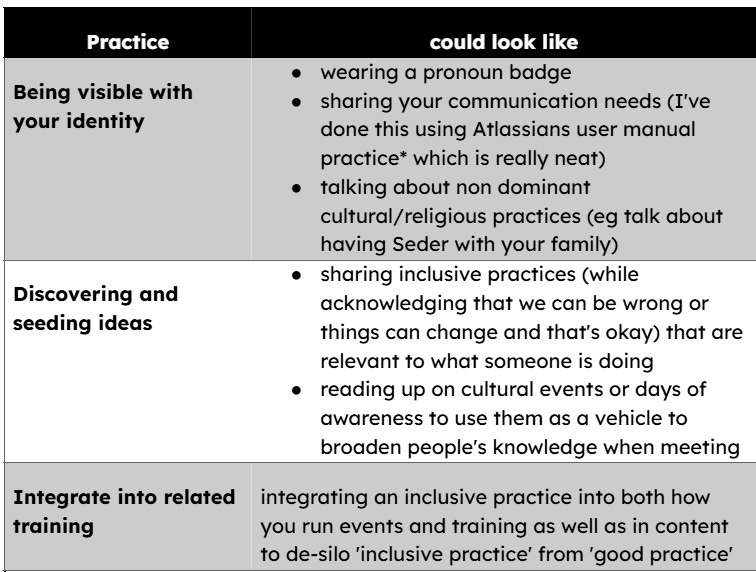
*https://www.atlassian.com/team-playbook/plays/my-user-manual
Organising benefits
I've recently been involved in building (and cobuilding) two different (informal) allyship networks and these can be really productive.
They can yield opportunities to
re-energise when feeling disappointed by a lack of progress (a little reminder that yes the barriers you're facing are real and not to give up because what you're doing is important)
Learn about diversity and inclusive practices from near peers including all the success stories and pitfalls
Organise together and amplify good work to get momentum behind initiatives
This is what I've seen already through the two networks mentioned and has been great certainly at keeping me motivated to progress the important work of equity and wellbeing.
Organising: how to
Not everyone needs to make a network of course and not every network will achieve what you need, so here are some next steps.
First of all, check if what you want already exists for you to jump on board, this will be far more sustainable than having two or more of the same
If what you want to make doesn't exist yet, here are the practices we engaged in to form ours. Most of these relate to having a clear purpose, ensuring sustainability, and psychological safety
Developing a shared vision and purpose (one of mine was quite quickly established while the other remains a permanent work in progress to discover what it needs to be over time -- both are entirely valid)
Codeveloping a social contract including how to address minor issues and consequences of major breaches
Careful guardrails around who can join to ensure the psychological safety of those within (we used an expression of interest form asking particularly *why* folks wanted to join to help ensure genuineness in applying)
A flat hierarchy with shared leading and decision making (be careful inviting senior leaders for this reason)
Codeveloped ways of working and communicating to ensure that all members would be able to contribute and participate meaningfully
Distributed responsibility so that the body will live beyond the energy levels of a single very motivated human
With much of this being codevelopment, it is difficult to predetermine exactly the nature in advance but it is interesting that there was considerable overlap in both groups social contracts and purpose statements (at least so far, both also remained open to changing as they grow and develop)
Reflecting once again on third space relevance
One of the unique aspects of all four the "particularly well placed if" here is that with all of those together, you will not only have the trust of others in establishing something like this (further amplified by the codevelopment process) but you will also have a very good guess for a starting group to act as the seed of the network or community which will allow it to become self sustaining
This is all well and good but I feel overwhelmed by the various things and by gosh this feels like a long post now and I think this heading is far too long please stop
I hear you. It can definitely feel like there's just too much to do and that needs to be done. It can't all be done by you, this work is a whole-of-organisation/community piece.
Instead of trying to do everything, just do one thing. What's one thing you want to do based on what you've read?
What can you do…
this week?
this month?
this year?
Remember, you don't need to change the world, to change someone's world!